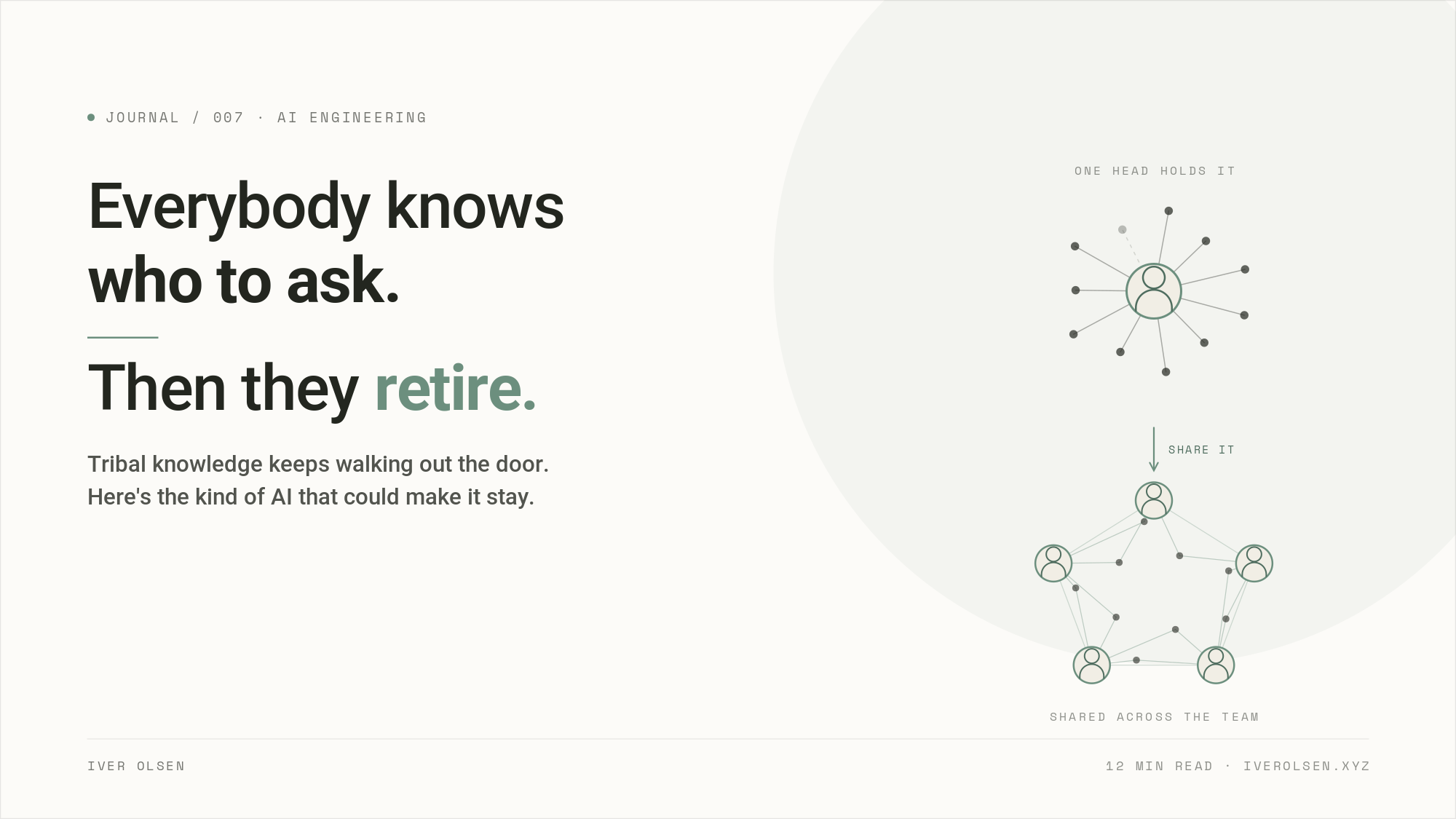
Everybody Knows Who to Ask. Then They Retire.
Why tribal knowledge keeps walking out the door, and the kind of AI that could make it stay
The most useful skill I’ve developed in fifteen years across labs, factories, and quality systems has nothing to do with materials or statistics. It’s knowing who to ask. In every organization I’ve worked in there’s a person, sometimes two or three, who holds the map of how things actually work. They don’t always have the answer, but when they don’t they can still point you toward whoever does and save you weeks of wandering. Knowing where the knowledge lives is its own kind of knowledge, and still to this day, being good at this has been like a superpower for me.
The problem with that skill is that it has an expiration date, and the date is whenever that person walks out the door. They retire after thirty years, or they take a better offer, and the map goes with them. Every organization I’ve been part of has gone through this, and most of them tried to fix it the same two ways. The first is to pour the knowledge into another person, a successor or a mentee, which mostly relocates the single point of failure rather than removing it. The second is to write it all down into a system, which is how you end up with a SharePoint graveyard nobody can navigate. Neither has really worked, and I don’t think that’s a coincidence.
What’s changed is that the tools finally exist to make the second approach work, but a lot of orgs are losing the plot. It isn’t an oracle that replaces the expert; it’s institutional memory wired into the systems where the work already happens, retrieval that surfaces the right prior case, suggested updates a human approves, and a record of who decided what and why. It’s a far less glamorous machine than the demo, and it’s the one I think actually sticks. The rest of this post is the argument for it, including the part where it goes wrong.
The Cost of Knowledge That Lives in One Head
Every time someone who mattered has left a team I was on, the same thing happened: a slow leak of the small answers nobody realized they relied on until they were gone. Which supplier’s certs you can trust without a re-test. Why the spec says 0.012 and not 0.010. Which line runs hot in August. None of it was secret, and almost none of it was written down.
There’s a vendor survey that tries to put a number on this, and I’d take it with the usual grain of salt because the vendor sells knowledge-capture software, but it matches what I’ve seen: in a poll of a thousand U.S. employees, about forty-two percent of the knowledge needed to do a given job was reported as living in one person’s head, shared with no one else on the team.[1] Call the exact figure soft; the shape of it is right. When that person is out, a chunk of the job becomes guesswork for whoever inherits it.
And the timing is bad. 2025 was the peak of the “Peak 65” wave, with more than four million Americans turning sixty-five in a single year, the highest count on record.[2] Turning sixty-five is not the same as retiring, but the direction is unmistakable: the people holding the deepest institutional memory are heading for the door, and in most places no one has written down what they know, because the part they know best is the part that was never written down.
What We’ve Tried, and Why It Keeps Slipping
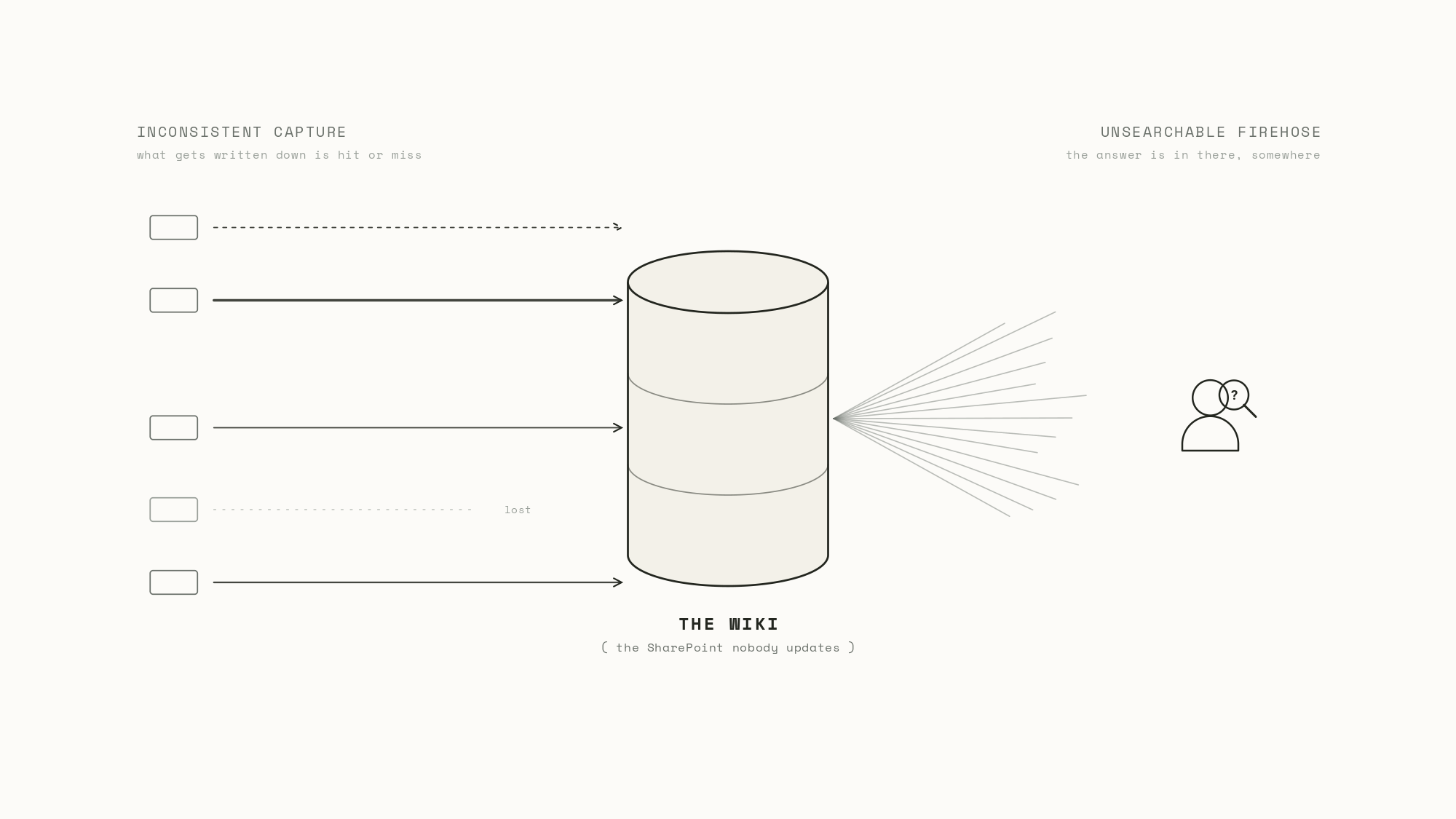
Start with the systems, because that’s where most organizations reach first. Every company I’ve worked for has had a bunch of wikis or SharePoints, and every one of them, some better than others, eventually turned into a graveyard. The failure happens at both ends. On the capture end, people write things down inconsistently and nobody agrees on what’s even worth capturing, so the record becomes a patchwork of half-documented procedures and somebody’s meeting notes from 2014. On the retrieval end you’re left drinking from a firehose of unstructured documents, and SharePoint search is, charitably, not good, so even when the answer is technically in there, finding it costs more than just asking the person down the hall.
The systems that look healthy are often either the most fragile or the most expensive to keep alive. I once inherited a specification that everyone assured me was in great shape, a clean document with an Excel spreadsheet embedded inside the Word file (a small crime in its own right) that the previous owner had, in everyone’s telling, maintained perfectly. The expectation was that I’d step in and keep the plates spinning, but that spreadsheet encoded a decade of one person’s judgment about what mattered with none of the reasoning attached. I could have kept it limping along for a while, but it never made sense to me, and it was nowhere near sustainable.
So organizations try the other approach and transfer the knowledge into a person. I’ve been on the receiving end of this one. In a previous role I spent years being mentored by a thirty-year veteran I’ll call Bob, and it worked about as well as mentorship can work. He was generous with what he knew, I learned an enormous amount and we got along great. I still bring him up regularly, and we catch up a couple of times a year. But the nicknames gave the whole thing away: I was “the new Bob,” or “Bob Jr.,” as if the goal were to print a second copy of a person. I wasn’t Bob, and I was never going to be. Eventually the role stopped being the right fit and I moved on, Bob retired a while later, and the knowledge those years were meant to preserve mostly left with us. The deeper problem wasn’t that either of us left, because people always do. It’s that the organization never built anything to hold what Bob knew outside of Bob, and outside of me, so when our paths diverged the context had nowhere to live. The company is doing fine, but that knowledge mostly didn’t survive.
Underneath both failures is the same issue, and it’s the reason this problem is hard rather than just neglected: the knowledge that matters most is tacit. The philosopher Michael Polanyi summed it up as “we know more than we can tell,” and anyone who has tried to write down exactly how they judge whether a process is about to drift, or which supplier’s certs to trust, knows the feeling of the important part slipping through the words.[3] Mentorship at least transmits the tacit part, person to person, which is why the old knowledge-management research treated it as the right tool for exactly this kind of knowledge. The catch is that it transmits to one person at a time and survives only as long as they stay.
From Successors to Systems
This is where the old research and the new tools point the same way. In 1999, Hansen, Nohria, and Tierney split knowledge strategies into two: codification, which pulls knowledge out of people and into documents and databases, and personalization, which keeps it with people and moves it through conversation.[4] Their finding, which held up for twenty years, was that you mostly have to choose, and that tacit, judgment-heavy work belonged with people, because codification couldn’t carry it. Mentorship over wikis, for exactly the reason mine kept outrunning every document I tried to write.
What changed is the cost and reach of codification. In one study, just over five thousand customer-support agents were given an AI assistant trained on their own past conversations, and output rose fourteen percent on average and thirty-four percent for the newest workers, with almost no effect on the veterans, because the system spread the best people’s patterns to everyone else.[5] That is the easy case, high-volume and structured with a clean answer key, about as far from messy engineering judgment as you can get, so I don’t read it as proof that the hard case works. I read it as proof that the mechanism is real: you can take the “who to ask” and make it available to the people who can’t walk over to that person’s desk.
I want to be precise, because this is easy to oversell. Retrieval is good at surfacing the explicit residue of work, the resolved cases, the documents, the reasoning around a decision, which is exactly what the wiki buried. It does not capture the tacit judgment itself and it does not make the call for you. RAG is part of the solution, not the whole of it, and the system worth building treats the expert’s judgment as the thing to support, not the thing to replace.
What I’d Actually Build
So I wouldn’t start with a chatbot bolted onto the company wiki. I’d start with one workflow where the knowledge already leaves a trail.
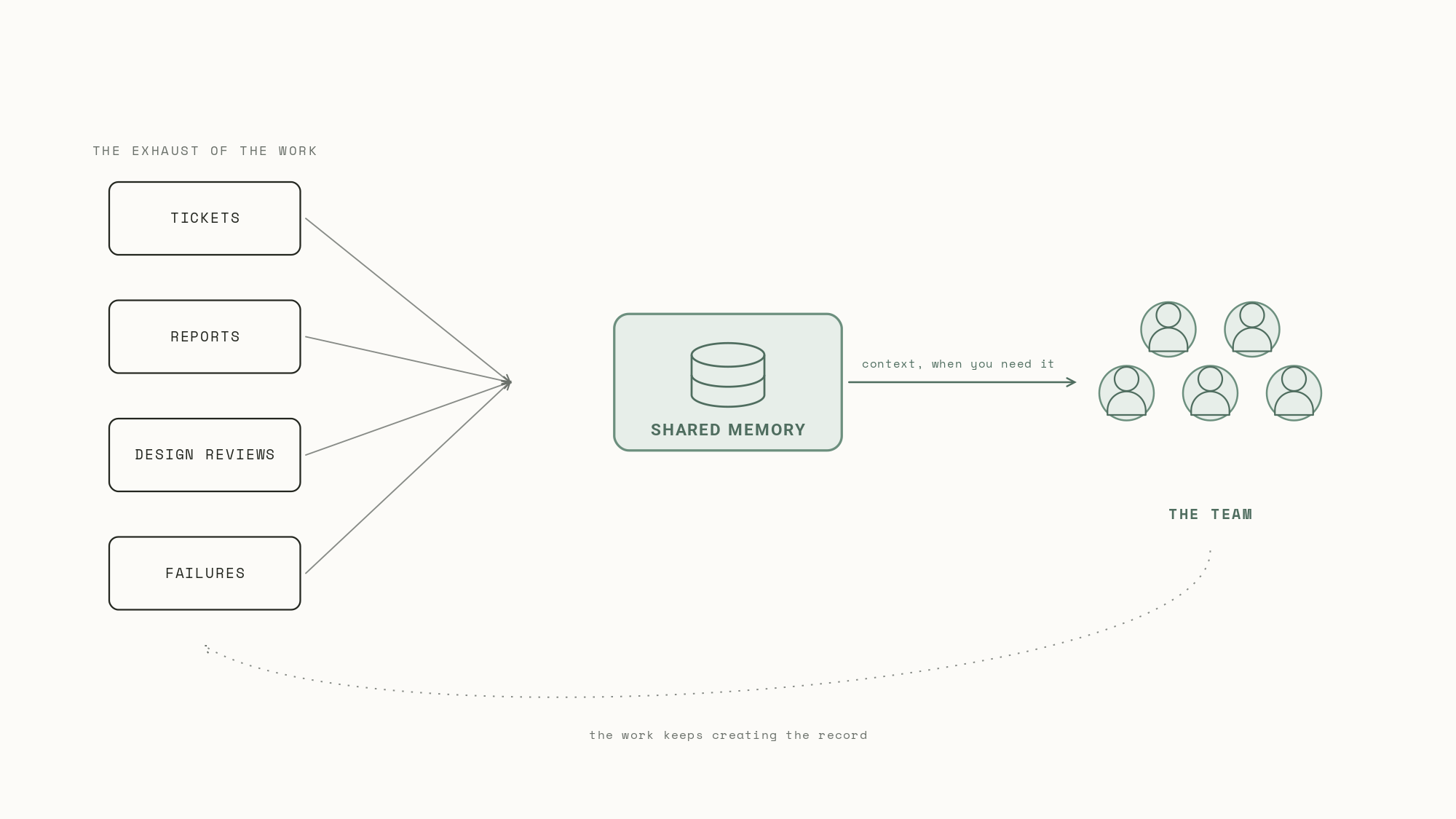
In a regulated manufacturer that trail is everywhere: nonconformance reports, CAPAs, design reviews, customer complaints, supplier issues, process deviations, FMEA revisions. Every one of those is a structured record of something going wrong and somebody deciding what to do about it, which means it is the tacit reasoning of the place, already half-written and already sitting in the QMS. The mistake is to ask people to document more on top of their day. They won’t, and you’ll have built another graveyard. I think the right move is to mine the trail that already exists.
Take a single workflow, say CAPAs. When an engineer opens a new one, the system retrieves the handful of prior cases that genuinely resemble it, and surfaces what was tried, what worked, and who signed off, with a link back to the source record every time so nothing is a black box. When a new failure or field return lands, it drafts the suggested FMEA update and routes it to the right reviewers through the same approval the document already requires, so the expensive part stops being the blank page and becomes a fast yes-or-no. The engineer’s judgment still gates everything; the system just means that judgment no longer starts from scratch, or from one person’s memory. I’ve described a smaller version of this before, an operator whose instinct for a drifting line gets backed by a model that has seen every run they weren’t there for.[6]
The unglamorous parts are where it lives or dies. Retrieval has to be permission-aware, because not everyone should see every program. Every answer needs a citation to the controlled document it came from. Stale content has to be flagged rather than confidently repeated, because a design rule that was true three revisions ago might now be a liability. There is an audit log, because in this world “the model suggested it” is not a defense. And there is an evaluation set with real review of the false positives and false negatives, because a knowledge system that is confidently wrong in a regulated environment might land you with a fresh CAPA or worse yet, a recall. None of that lives in a separate AI portal people have to remember to open. It lives inside the QMS, the PLM, and the MES, where the work already happens.
You can’t really measure this with a model benchmark, you need to measure whether the newer engineers find answers faster, whether the experts get asked the same question less often, whether repeat failures actually drop, and whether the controlled documents finally stay current on their own.
Without Turning It Into Surveillance
The fastest way to capture what an expert knows is to watch everything they do, and that runs straight into a wall most people won’t climb over. When the Pew Research Center asked Americans about AI that monitors and evaluates workers, large majorities were against it: sixty-one percent opposed to tracking their movements, fifty-six percent to logging their time at the desk, and the people most opposed were the ones actually doing the jobs.[7] You don’t have to imagine where that leads. Meta spent early 2026 rolling out a program that logged employees’ keystrokes, mouse movements, and on-screen activity to train AI agents on how the work gets done; it was reported and protested in April and pared back under pressure by June, after staff objected both to the surveillance and to the obvious subtext that they were generating the data to automate their own jobs.[8] You cannot build an institutional memory on a foundation your own people experience as surveillance.
The replacement fear is the harder one, because it is rational. You can imagine the darker version of everything I just proposed: interview the thirty-year veteran on her way out, feed the transcript to a model, and call it succession planning. You are asking someone to spend their last months training their own stand-in, which reasonable people don’t want to do, especially while the loud story about AI is headcount reduction - not a good look. I’ve argued elsewhere that the headcount story is the wrong one,[6] but being right about that doesn’t make the fear evaporate.
So the version that works has to clear a higher bar than the technology. It captures from the exhaust of work that’s already happening rather than from new monitoring bolted onto people. It is transparent about what it holds and honest about who can see it. And it has to make the expert’s own day better, surfacing what they need instead of grading them, or they will quietly stop feeding it and you will have spent a lot of money teaching your best people to withhold. The audit trail and the permissions aren’t compliance theater here; they are what makes the thing safe enough for people to actually use.
Where I’d Put My Chips
I’ve landed somewhere in the middle, but not on the fence. People still hold judgment no system fully captures, and the old research was right that you can’t codify your way out of that. What’s new is that you no longer have to choose codification or people: a workflow-native memory system lets the documents carry the explicit half, so the experts can spend their judgment on the half that is actually hard.
The failure modes are easy to name. Don’t try to clone Bob and definitely don’t build another SharePoint graveyard. Also, maybe don’t bolt surveillance onto people and call it knowledge management (looking at you Zuck). The thing worth building captures knowledge as a byproduct of the work, cites its sources, keeps a human in the loop, and gives people their time back instead of taking their place.
That’s the bet I’m making in my own work: retrieval wired into the systems that already run the job, suggested updates a human approves, and the people with the real expertise helping decide what’s worth capturing in the first place, because that, not the model, is the hard part. I don’t think this is solved. I think it’s finally buildable, and I’d rather build it in the open. If you’ve watched a wiki die, inherited a spreadsheet you couldn’t run, or found something that actually made institutional knowledge outlast the expert, I want to hear about it.
References
[1] Panopto / YouGov, “Valuing Workplace Knowledge,” 2018 (vendor-sponsored survey of 1,001 U.S. employees; 42% of institutional knowledge reported as unique to the individual; ~5.3 hours/week lost). prnewswire.com
[2] Alliance for Lifetime Income, Retirement Income Institute. “Peak 65” (about 4.18 million Americans turning 65 in 2025, ~11,400/day, the highest on record). prnewswire.com
[3] Polanyi, Michael. The Tacit Dimension (“we know more than we can tell”). en.wikipedia.org
[4] Hansen, M., Nohria, N., Tierney, T. “What’s Your Strategy for Managing Knowledge?” Harvard Business Review, 1999 (codification vs. personalization). hbr.org
[5] Brynjolfsson, E., Li, D., Raymond, L. “Generative AI at Work.” NBER Working Paper 31161 / Quarterly Journal of Economics, 2025 (14% average productivity gain, 34% for novices, by disseminating the best practices of top workers). nber.org
[6] Olsen, Iver. “We’ve Been Having the Wrong Conversation About AI.” iverolsen.xyz
[7] Pew Research Center. “Americans’ Views on the Use of AI to Monitor and Evaluate Workers,” 2023 (majorities oppose AI workplace monitoring; workers more opposed than non-workers). pewresearch.org
[8] HR Grapevine / Reuters. “Meta Scales Back AI Employee Monitoring Tool After Staff Backlash,” June 2026 (Meta’s Model Capability Initiative logged keystrokes, mouse movements, and on-screen activity on U.S. employees’ computers to train AI agents; reported and protested April 2026, pared back June 2026). hrgrapevine.com