Below the Limit of Detection
The World Cup ball is deciding matches on evidence the public can't audit. Here's my take on what FIFA could do to win our trust.
I run a testing lab for a medical device manufacturer, which means a large portion of my working life is spent deciding whether to believe an instrument. Method validation, limit-of-detection studies, gage R&R: the unglamorous paperwork that turns a number on a screen into something you can defend to an auditor. In my world, we have to show our work even when the result isn’t what we wanted. I’m also a football fan (Heia Norge!), so when I watched FIFA disallowing a World Cup equalizer this month because a chip inside the ball registered a touch that nobody could see on video, I had some skepticism.
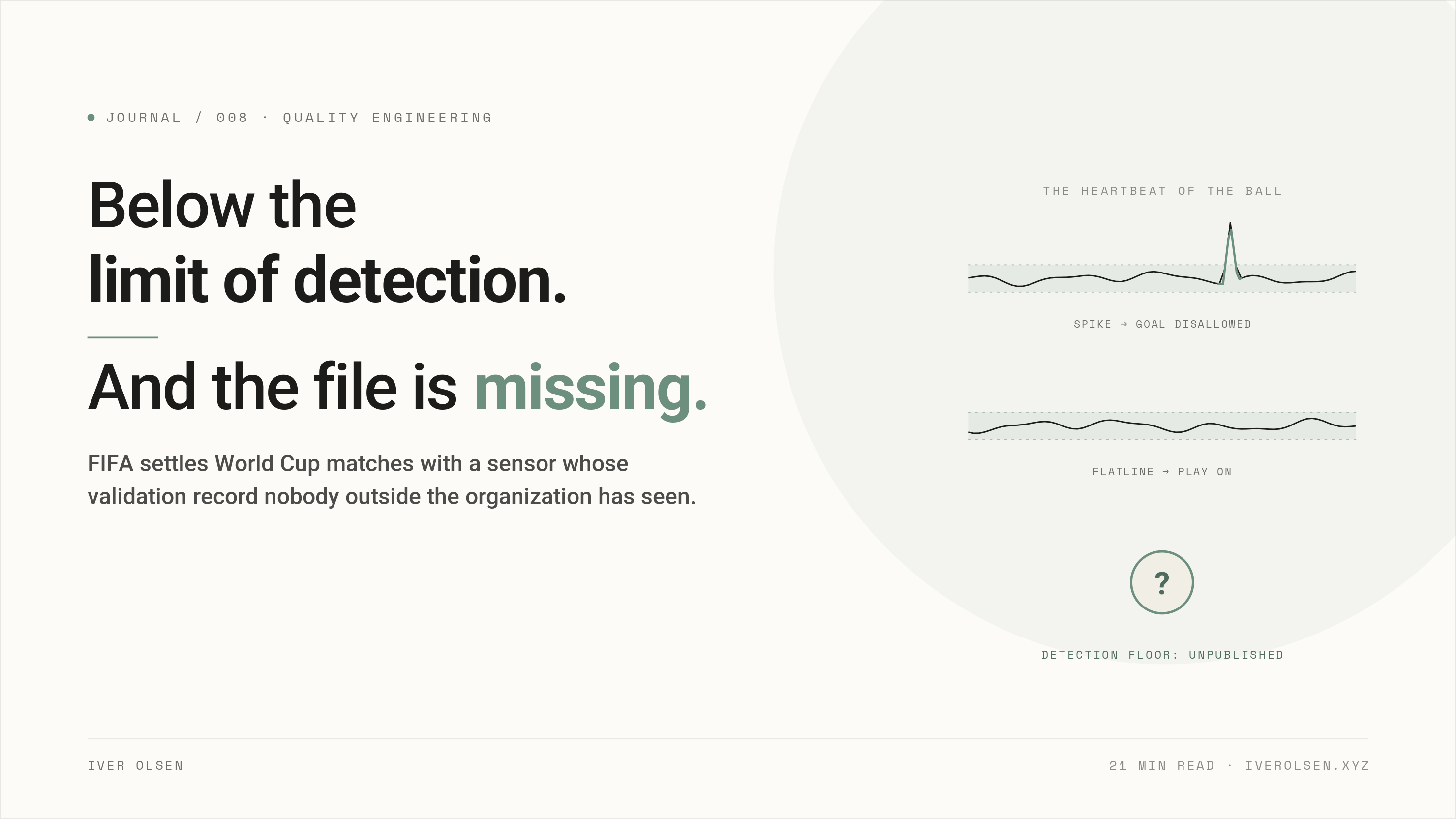
Nine days after seeing Croatia get eliminated by this sensor, I saw the same chip used to “prove” the opposite claim, and my skepticism grew to the point that I wanted to investigate further. During Norway’s quarterfinal, a goal kick appeared to clip the Spidercam wire above the pitch moments before England’s equalizer. This time FIFA pointed to the absence of a signal: “the sensor in the Connected Ball showed no peak in the ‘heartbeat of the ball’ when in the air, and therefore no evidence that the ball touched the overhead wire.”[1] A detected minuscule spike had ended Croatia’s tournament, and now an undetected touch seemed to help send Norway home. Two opposite instances relying on the same instrument, but how can we rely on this sensor without seeing validation data?
The first thing I went looking for was a limit of detection, and behind it the artifacts any event detector needs. FIFA and Adidas publicly describe a 500 Hz in-ball IMU used alongside tracking cameras, so it was pretty easy to get a picture of the system. However, what I haven’t found is a public validation report for the system’s core job, the touch-detection decision itself. After an extensive search: no published detection curve, no false-positive rate, no declared decision threshold, no stated operating envelope, and nothing of the kind in FIFA’s quality programmes, the peer-reviewed literature, or anything Kinexon or Adidas has released across four years of connected-ball officiating. That leaves outsiders unable to evaluate how much weight a particular disputed signal should carry. The ball’s rebound height has a public test manual with pass criteria, but the sensor making multi-million dollar decisions during knockout matches does not. The rest of this post is what I was able to reconstruct of the public records, and what it would take in ordinary laboratory terms, to earn the claims being made on that sensor’s behalf.
Two Calls, Nine Days Apart
The Croatia call first: Round of 32, July 2 in Toronto, Portugal up 2-1 deep in added time when Josko Gvardiol put the ball in the net for what looked like the equalizer. The VAR sent referee Espen Eskås to the monitor, and the goal came off the board: ball data showed a graze off Igor Matanović in the buildup from Ivan Perišić’s cross, which put Mario Pašalić offside before the finish. The touch, in the AP’s words, was “undetectable to the naked eye and even video replays.”[2] Broadcast viewers got FIFA’s heartbeat graphic instead, a flat trace with a spike at the moment of contact, and FIFA’s statement declared that the data “proven that contact was made” by sensors “capable of determining any slight contact.”[3] Matanović, to his credit, didn’t dispute the physics. “I felt a slight contact with my hair,” he said afterward.[4]
Croatia’s federation filed a formal complaint calling the decision an abuse of technology.[5] Interestingly, their argument wasn’t about the ball sensor; they stuck to the rule book. Croatian outlets circulated a claim that FIFA guidance counts hair as part of the body only when it affects the ball’s movement. I went looking for that rule and couldn’t find it in any primary source; FIFA’s own statement never mentions hair at all, only that contact was made. The IFAB glossary defines “play” as “action by a player which makes contact with the ball,” with no minimum attached,[6] so there is no floor in the rulebook, which means that a call like this rests on the detector and wherever its threshold sits.
The Norway call is the stranger one. In first-half stoppage time of the July 11 quarterfinal in Miami, Ørjan Nyland’s goal kick sailed, and in ESPN’s description England took control “seconds after the trajectory of the ball changed, suggesting it brushed one of the cables” holding the broadcast camera above the pitch.[1] The laws call for a stoppage and a drop ball when that happens. Play ran on, England countered, Jude Bellingham scored (a beautiful touch, I should add), and England eventually won 2-1 after extra time. FIFA’s defense again pointed to the sensor but this time the graph was the flatline, no peak in the heartbeat, therefore no contact. Norway’s coach Ståle Solbakken gave the quote of the tournament on the epistemology of it: “If there’s been no reading in the chip, what can I say against that? But the ball drops down straight from heaven, says everyone, including Ørjan, who is the goalie.”[7] The fan in me was not satisfied.
The story grew over the next two days as the BBC’s 3D replay reconstruction went viral, seeming to confirm the wire strike. Then FIFA produced footage from the cable camera itself, which showed no shake at the moment in question. The same 3D replay tool turned out to have misread a ball’s flight earlier in the tournament, and a screenshot shared by the BBC’s VAR analyst, attributed to FIFA’s connected-ball data, showed the ball’s trace running continuous through the disputed interval on both the accelerometer and the gyroscope, with no event where the wire strike was supposed to be.[23] Although it seemed clear during the match, it’s starting to look like my eyes deceived me.
The two instances are examples of the same instrument being asked to make opposing decisions. In Toronto we were asked to believe that a brush with human hair could be detected by the ball mid-flight, while in Miami we were asked if every contact is guaranteed to be caught by the system. An absence-of-evidence argument is only as strong as your knowledge of the reliability of the detection system, particularly at varying velocities and intensities. It took several days, but Miami’s absence argument eventually drew corroboration from outside the sensor. But what about all of the calls that don’t have additional evidence? That’s where a publicly available paper trail of system validation should come in.
What the Chip Actually Is
The device inside the ball is a package of roughly fourteen grams built by Kinexon, a Munich sensor company, and it carries more than one kind of instrument, which coverage tends to blur together. Kinexon’s broader connected-ball products combine location and inertial sensing,[9] while FIFA’s public descriptions of the World Cup system say the 500 Hz in-ball IMU works alongside optical tracking cameras.[8][19] The public descriptions do not spell out how the IMU, cameras, and any location system are combined for each decision. I continue to see the system’s defenders answering questions about touch detection with positional data. In an article about the Croatia call, the expert opinion provided was: “No matter how fast the ball is moving or the spin of the ball, you can track it really effectively,” the AP was told by Professor Manos Tentzeris from Georgia Tech’s school of electrical and computer engineering. “The position of the ball is 99.99% accurate … you know exactly where the players are, even the tip of a shoe, which sometimes determines if someone is offside or onside.”[2] I’m not disputing that, but what I am asking is, even though we can track that the ball was above his head at the time of the blip on the sensor, how do we trust the blip on the sensor is real?
In the 2022 Al Rihla, the sensor hung at the ball’s geometric center in a suspension system Adidas patented and declined to describe.[8] For 2026 the Trionda moved it into one of the ball’s outer panels, with counterweights in the others to preserve balance.[10] The IMU’s specifications have never been officially published, but trade press quoting TDK InvenSense describes a wide-range part sampling at 500 Hz with a ±30 g accelerometer and a ±4,000 degree-per-second gyroscope,[11] numbers that match TDK’s ICM-20649, a sensor marketed for “sports and high impact applications,” almost line for line.[12] Grain of salt here: the part number is my inference from the specification match, TDK now lists that part as obsolete, and a matching range and noise density would tell you nothing about the 2026 ball’s filter configuration, bandwidth, or algorithm in any case. Nothing about the chip’s identity is published, as far as I can find.
A ±30 g accelerometer might sound generous until you look at what a football actually experiences. An instep kick delivers a peak force around 2,900 newtons over roughly ten milliseconds of contact,[13] which on a 430-gram ball works out to hundreds of g at the center of mass, and published smart-ball measurements put routine impacts beyond 100 g.[14] Depending on the installed range, mounting, and filtering, a hard kick could drive the accelerometer toward saturation, while a very small contact could be difficult to separate from ordinary vibration and ball motion, and public information does not let us determine where that boundary lies. If the range is anything like the reported spec, the channel would be better suited to timing than waveform capture on hard contacts. What the “heartbeat” graphic actually computes from that channel and the others is unpublished, and it could key off acceleration, rotation, some fusion of the two, or a trained classifier sitting on top of all of it, with nothing public saying which. Every question about faint contacts therefore becomes a question about an undisclosed decision rule, and about where its threshold sits relative to the noise.
The Paper Trail
FIFA does publish rigorous test methods for the ball. The Quality Programme for footballs specifies seven laboratory tests with pass criteria: weight, circumference, roundness, rebound, water absorption, pressure loss, and shape retention.[15] A connected ball carrying the FIFA Quality Pro mark has passed exactly those, and none of these tests has anything to do with the sensor inside it. A second programme, EPTS, covers tracking systems: candidates are graded against reference-grade optical motion capture at an accredited institute, for player and ball position accuracy.[16] Between them, the two programmes cover the ball as an object and the tracking as a map, but neither says anything about the touch function.
One relevant peer-reviewed study is from 2021, when researchers at TU Munich ran Kinexon’s system against a thirty-camera motion-capture reference and reported position errors of 8 to 9 centimeters for players and 15 centimeters for the ball in 2D, rising to 17 to 21 centimeters for 3D impact locations. Their conclusion on officiating was “For officiating purposes such as hawkeye in tennis, where error rates of well under 1 cm are achieved, the ball tracking should not yet be used.”[17] Fairness requires qualifications: that study tested a commercially available Kinexon positioning tag sampling the ball at 50 Hz, not the 2026 connected ball or its touch function, and 2021 is not 2026. FIFA also publishes current performance reports for the tracking systems it certifies,[16] which is real transparency as far as it goes; those reports grade position. But the 2021 study remains the closest thing to independent, peer-reviewed scrutiny this ball’s tracking has received, and it recommended against the kind of use it examined.
Touch detection is not unstudied in the open literature. A 2025 Sports Engineering paper from FIFA-affiliated researchers evaluates a semi-automated last-touch method built on skeletal and ball tracking data, reporting up to 82.5% correct possession decisions on duels from the 2022 World Cup.[24] That method runs on the camera side rather than the ball’s chip, so it does not validate the connected-ball IMU, but it shows that this kind of performance reporting is publishable, and that the reporting exists for the camera method while nothing equivalent is public for the in-ball sensor’s touch decision.
The public record for the touch function appears limited to press releases. FIFA’s page on semi-automated offside says the system was “successfully trialled” at tournaments in 2021.[18] FIFA also documented connected-ball testing at the December 2025 Intercontinental Cup, where the match balls carried a sensor “providing 500 IMU data points per second, assisting the VAR in determining player contact with the ball,“[19] and its research programme page describes a “pivotal role in developing and validating” the offside technology.[20] What none of these pages contains, from 2021 through 2026, is a performance number for touch detection: no error figures, no ground-truth methodology, no definition of success. There is no published decision rule, no sensitivity or false-positive rate, no detection-probability curve, no independent study comparing the chip’s touch calls against high-speed cameras. I looked for a standard underneath it and found none: no IFAB accuracy specification, no ISO test method, no public calibration or traceability requirement. And the relevant event-level data and validation material are not publicly accessible.
This is an information vacuum. Search for the sensor’s performance and you’ll find precise-sounding figures, a 99.7% agreement with 1,000 Hz cameras, a 50 g detection threshold, ±2 to 3 millisecond timing, none of which traces back to FIFA, Kinexon, Adidas, or any paper. All of this info is circulating through AI-generated content farms, invented specifics laundered into search results. Oddly, where real validation data is unpublished it seems that completely fabricated validation data is filling the void.
How a Lab Would Do It
The validation framework is pretty standard, even though the test methods aren’t, and executing it well is not something I would label as trivial. A credible public validation would define the measurand, include verified non-contact blanks and controlled contacts, use independent ground truth such as high-speed video and load-cell instrumentation, and report probability of detection and false-alarm rate across the conditions the ball is meant to face.
You start by defining the measurand, because “a touch” is not a physical quantity. Instead, we’d need to measure impulse in newton-seconds, or the velocity change it produces at the ball’s center of mass. Additionally, we’d measure the rotational component, angular impulse, which lives on the gyroscope channel. From there you’d start by characterizing the blank (your negative control data): this would include stretches with no player or external contact at all, the ball simply in flight with its spin, drag, and buffeting, so you can count how often the detector fires on nothing. That’s your false-alarm rate (Type 1 failures). Kicks and bounces are contacts, and they belong in the positive class at its loud end (positive controls). These two sets of data form your endpoints, your measurement range.
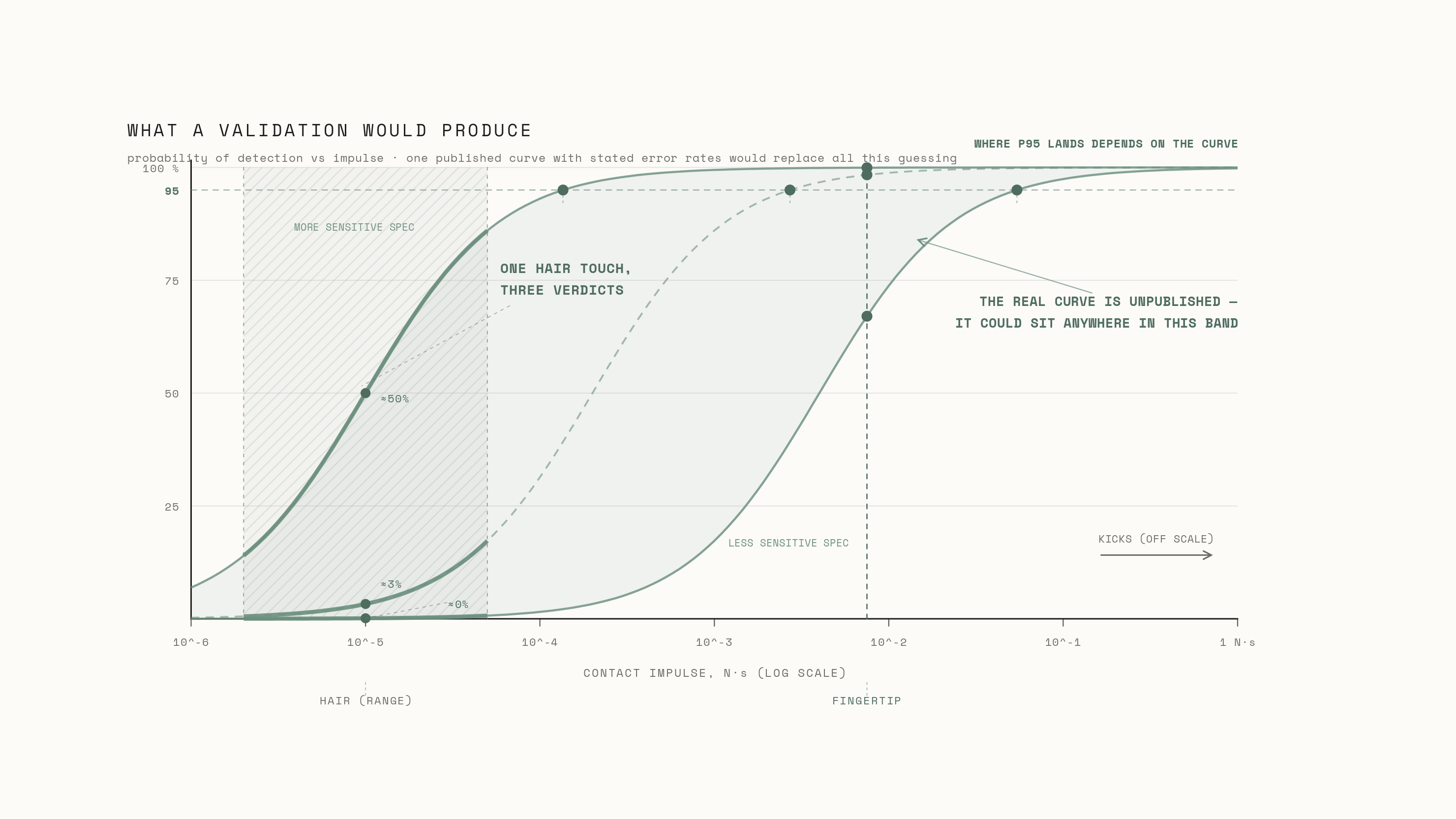
Then you need to map your calibration curve between those two points, using graded contacts with independent ground truth, with a load cell and a camera at a few thousand frames per second: touches spanning a firm header down to a deliberate hair-graze (if you can manage to capture it), so you can plot probability of detection against impulse. ISO 11843 (Capability of Detection) is very specific in that it distinguishes the critical value, the threshold that controls false alarms, from the minimum detectable value, the impulse the detector catches with stated probability. This is the number you’d defend in front of an auditor: at a given level of touch, is the impulse detected with 95% confidence? Was the detection above the noise floor at that intensity? This is where the real value is.
Next, the part that often makes test protocols balloon in size: how well does that detection curve hold up across different environmental conditions? Ball temperature and internal pressure, rain and surface wetness, ball age and the damage a match’s worth of impacts accumulates, firmware version, impact location and angle, spin, and speed, and across the tracking conditions of each individual stadium. Altitude belongs there too, thinner air changes ball flight and aerodynamic loading, which is the background the detector has to read against, not anything that degrades the MEMS sensor’s own accuracy.
Sports instrumentation on a different pitch already publishes to this standard. Instrumented mouthguards used for head-impact monitoring in rugby report sensitivity adjudicated against video (93.6% in one validation, for events above the system’s recording threshold) alongside true-positive, false-positive, and false-negative counts.[21] Although it’s not exactly the same, the template already exists for FIFA to follow. The irony to me is that the governing body publishes tighter public test criteria for how high the ball bounces than for the instrument whose word sends teams home from a World Cup.
The Napkin Math
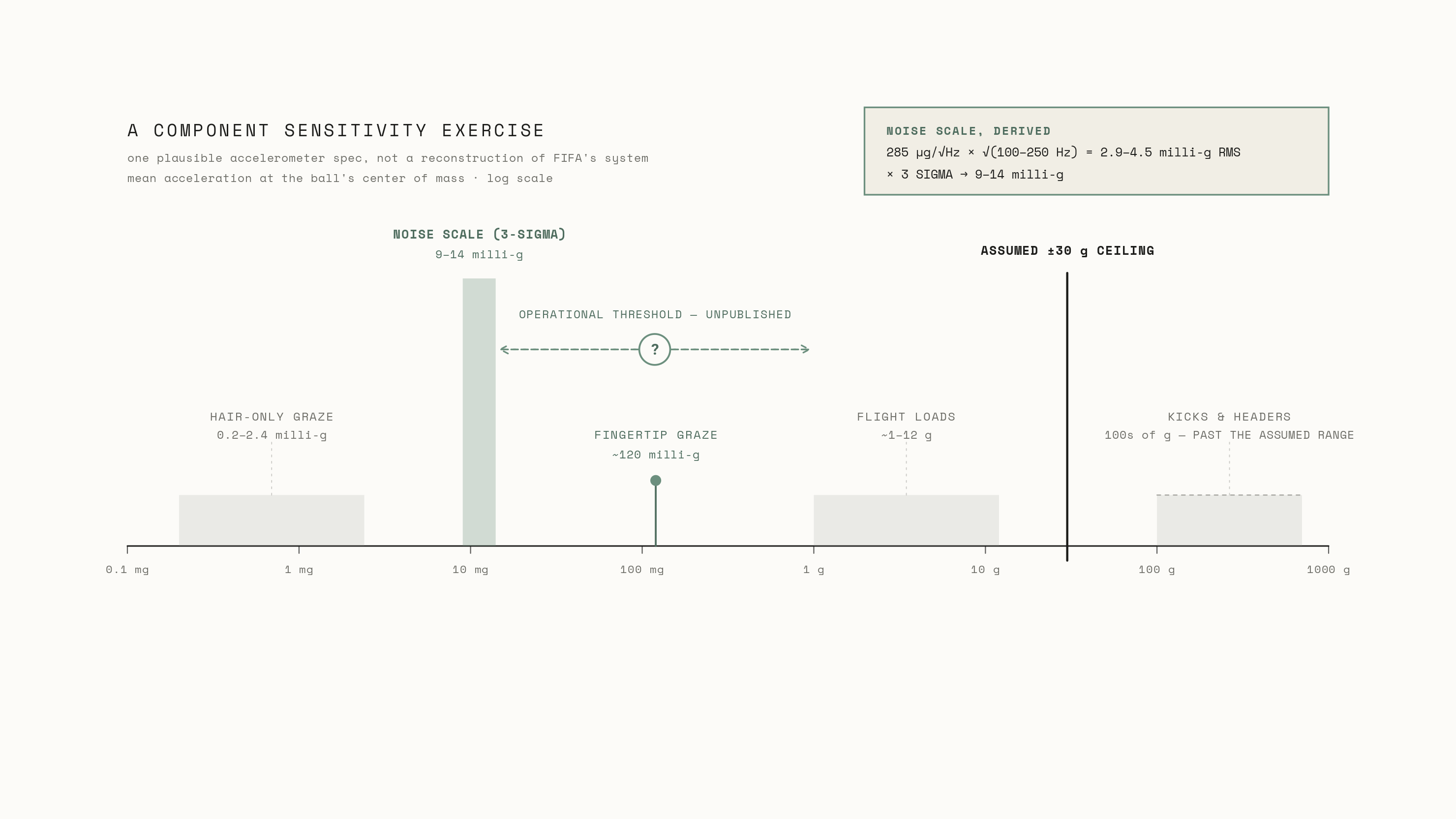
Since nobody will tell us the detection limit, we can at least size the physics. What follows is not a reconstruction of FIFA’s system: the exact chip, measurement range, mounting, filtering, fusion logic, and decision rule are not public. It is a sensitivity exercise using one plausible component specification,[12] useful for showing which missing parameters matter and incapable of establishing the ball’s actual limit of detection. A real classifier might beat these numbers by combining samples or fusing channels, or trail them once vibration, bias, and modelling error are in play. The forces and durations below are engineering SWAGs chosen to size the problem, since nobody has published measured values for grazes, which is rather the point.
285 µg/√Hz × √BW = 2.9–4.5 milli-g RMS
× 3σ → call it 9–14 milli-g
kick or header → 100s of g · past the assumed range
fingertip, 0.5 N × 15 ms → ~120 milli-g · ~10× the scale
hair alone, 1–10 mN → 0.2–2.4 milli-g · at or below the scale
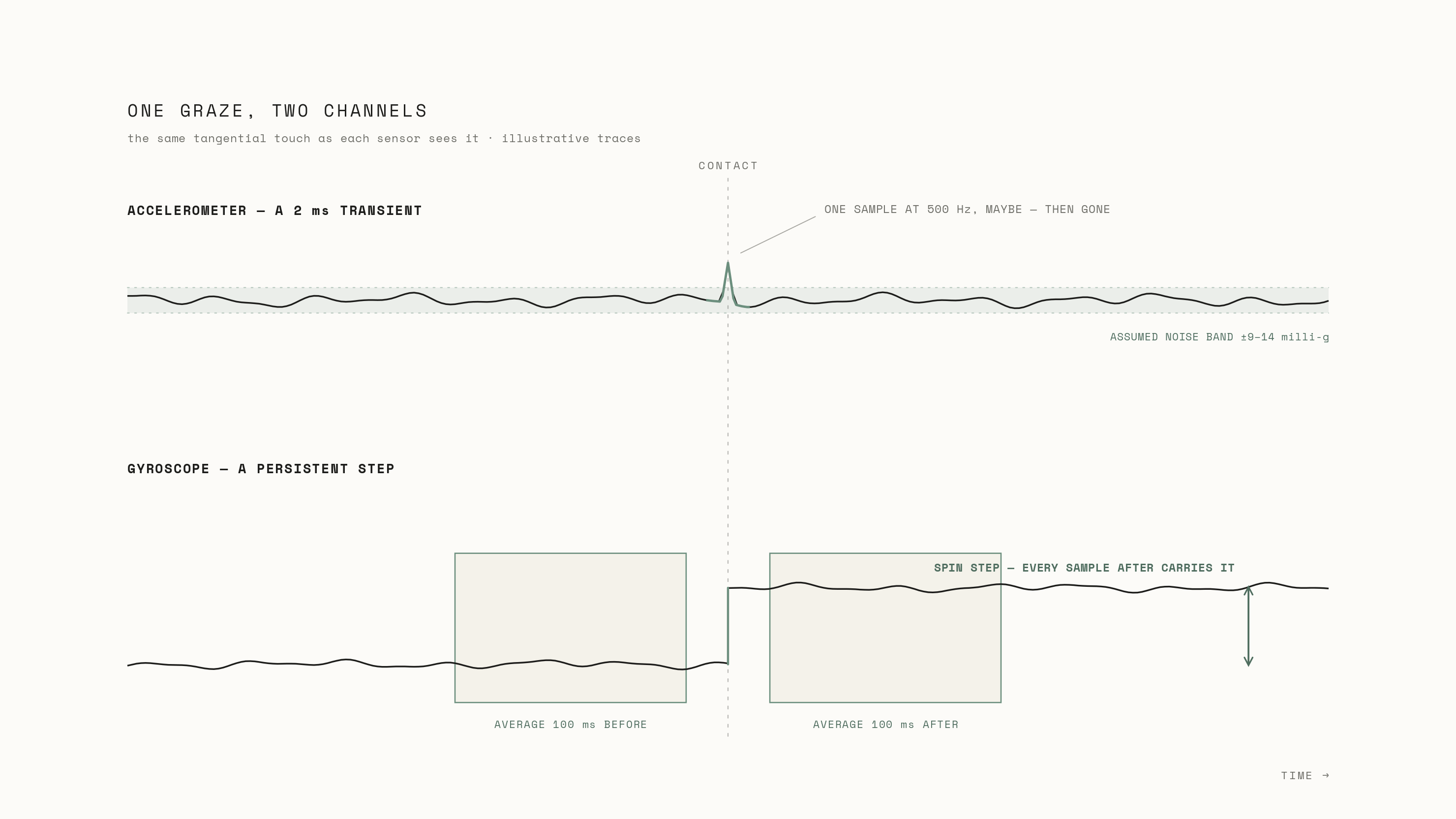
Δω/Δv = 3/(2r) ≈ 780 dps per m/s
averaged 100 ms windows → step detectable ≈ 0.2 dps
head-graze through hair, 2 N × 8 ms → ~29 dps · ~150× the scale
fingertip → ~14 dps · ~70× the scale
hair alone → 0.004–0.09 dps · below the scale
The same guessed touch reads as marginal on one channel and as a comfortable, persistent step on the other, because the accelerometer has to catch a milliseconds-long transient as it happens while the gyroscope gives a before and after picture. Which channel the real system reads, how the channels are fused, and where the threshold actually sits are unpublished, and from what I can put together those choices can move the answer by orders of magnitude.
The Sensor Isn’t the System
Nobody validates a load cell and then calls the test method validated (at least in any lab I’ve been in), because the method is a system: the fixture, the environment, the procedure, the operator, the samples, and the analysis, with the load cell as one link in the chain. The ball works the same way. Between the MEMS die and the referee’s monitor sit the mounting, the filtering, whatever fusion combines acceleration, rotation, and camera tracking, the decision rule that turns a signal into “contact,” and the graphic that presents the verdict, and every component affects what “detected” means. Validation attaches to that whole system or you’re just guessing.
The 2026 redesign means that we can’t rely on previous validation. Moving the IMU from the center suspension into an outer panel changes the motion the same chip sees: at a 9 to 10 centimeter offset, spin alone creates a centripetal background of ω²r, roughly 94 m/s² at five revolutions per second in the worst orientation, call it 10 g, climbing toward the assumed range at elite spin rates. The gyroscope reads the same anywhere in a rigid ball, so the relocation loads one channel and leaves the other untouched. This doesn’t prove that the 2026 ball performs worse; what I’m trying to point out is that “validated” is not a property a sensor carries with it between configurations. The system that includes the panel mount needs its own published envelope, exactly as the system that included the center suspension did.
Getting Back onto the Pitch
Let’s look at each call through both sensor channels. A “hair touch” in a header contest is realistically a graze of the head through hair, a tangential contact, which means we need to look at the spin arithmetic: per the cards above, contacts far too small to bend a trajectory visibly can still sit orders of magnitude above the gyroscope’s averaged noise, if the geometry is anything like the estimates above. What might have been invisible to the eye could potentially show up as a loud spike to the chip, which is a plausible story, but it wouldn’t match the graphic posted by FIFA: instead of a blip we should see a step in the data. While the Croatia spike is entirely believable as a real detection, the data we were shown isn’t convincing in my eyes. Additionally, what we don’t see is the decision rule that separated that spike from noise, and the operating envelope that says when the rule can be trusted.
I started writing this before all the info had come out about Miami, and it turned out differently than I expected. The rebuttal that settled it came from triangulated evidence: steady footage from the cable camera, the 3D replay tool’s documented failure mode, and the reported trace carrying both channels of the ball’s motion.[23] That trace shows the two channels this post has been reading, acceleration and rotation together, which is confirmation that touch evidence is a two-channel question. Still, the reported plot is a selected rendering of a single event, with no axis scales, no processing details, no threshold, and no error rates attached, what some would call a chart crime (myself included). A disputed flatline became credible within days precisely because the sensor evidence was corroborated and shown instead of asserted, and one reported plot makes a good precedent, but falls well short of a validation.
A validation record is also only half of operating a system like this. The other half is unglamorous discipline: firmware and algorithm versions under change control, per-ball identity with a pre-match health check, a defined handoff when the active ball is swapped, logged telemetry gaps and clock synchronization, calibration status, and an immutable record of exactly what the VAR was shown. But we’re also missing the fallback: when sensor health is unknown or the chip and the video disagree, what are the defined rules the officials follow for setting the graphic aside? To have this you need a system that exposes its uncertainty instead of broadcasting confidence.
The Point
After the Ronaldo header dispute in 2022, Adidas said its ball data could “definitively show no contact.”[22] Definitively is a word I don’t take lightly, you’ve got to earn it. You need at least the following: a stated measurand, a characterized blank (control), a detection-probability curve, published false-positive and false-negative rates, an uncertainty budget someone else can check. Nothing on that list threatens a trade secret and none of it should be proprietary. FIFA could publish the threshold in physical units and the detection curve behind it, and commission an independent audit of archived heartbeat traces against high-speed footage, and the technology would be easier to trust. Perhaps the Miami incident is the closest thing to a proof of concept, a reported trace and corroborating footage collapsed a viral accusation inside two days. Without the validation file, it’s hard for me not to think that the heartbeat graphic is authority dressed as empirical evidence.
The sensor may well perform beautifully inside an operating envelope FIFA has characterized and simply never published. The failure is that the public claims exceed the public evidence, and the gap is papered over with a broadcast graphic instead of a validation file. That choice is something I recognize from beyond football, we’re seeing more and more systems, sensors and models alike, issue verdicts that humans relay rather than judge, and the discipline that keeps such systems honest isn’t keeping up. Define what you measure, characterize where it fails, publish the error rates, and tell the official at the monitor where those limits are instead of assuring him there are none. The referee walking to the screen is good system design but telling him the sensor detects “any slight contact” is not.
Final caveats: None of this proves that the system made the wrong call. As a fan, and a scientist, I’m simply asking for transparency, the information required to know what the system can establish, and with what uncertainty. A flat line on a chart only means something after we know what the instrument can reliably detect, what it can miss, and how often it can be fooled. Additionally, I have to say as a fan that every team remaining in the tournament deserves to be there, an errant call determined by a sensor isn’t what got them there, although in some cases it might not have hurt their campaign.
References
[1] ESPN News Services. “FIFA denies ball hit wire in England’s first goal vs. Norway.” espn.com
[2] Associated Press (via Fox Sports). “This high-tech ball was involved in one of the most dramatic moments in World Cup history.” foxsports.com
[3] Goal.com. “FIFA defend VAR decision to disallow Croatia goal against Portugal.” goal.com
[4] Yahoo Sports. “‘I felt a slight contact with my hair’ — Croatia’s Matanović on the disallowed goal.” sports.yahoo.com
[5] Reuters (via Dawn). “FIFA’s embrace of technology backfires at World Cup.” dawn.com
[6] IFAB. “Glossary: Football Terms — ‘Play’.” Laws of the Game. theifab.com
[7] ESPN. “Norway head coach fumes at ‘clear’ TV cable assist on England goal.” espn.com
[8] Adidas press release. “adidas reveals the first FIFA World Cup official match ball featuring connected ball technology.” news.adidas.com
[9] FiveThirtyEight. “The World Cup’s New High-Tech Ball Will Change Soccer Forever.” fivethirtyeight.com
[10] Adidas press release. “adidas unveils Trionda — the Official Match Ball of the FIFA World Cup 26.” news.adidas.com
[11] Sensor Tips. “How do sensors help you play ball? Part 2.” sensortips.com
[12] TDK InvenSense. “ICM-20649 — Wide-Range 6-Axis MEMS MotionTracking Device for Sports and High Impact Applications.” product.tdk.com
[13] Shinkai, H., et al. “Ball impact dynamics of instep soccer kicking.” ISBS Conference Proceedings / Medicine & Science in Sports & Exercise, 2009. isbweb.org
[14] Stone, T., et al. “On Smart Soccer Ball as a Head Impact Sensor.” IEEE Transactions on Instrumentation and Measurement, 2019. icosmos.cs.umd.edu
[15] FIFA. “Testing Manual — FIFA Quality Programme for Footballs.” digitalhub.fifa.com
[16] FIFA. “EPTS Testing Process — FIFA Quality Programme for Electronic Performance and Tracking Systems.” inside.fifa.com
[17] Blauberger, P., Marzilger, R., Lames, M. “Validation of Player and Ball Tracking with a Local Positioning System.” Sensors 21(4):1465, 2021. mdpi.com
[18] FIFA. “Semi-automated offside technology.” inside.fifa.com
[19] FIFA. “FIFA uses FIFA Intercontinental Cup 2025™ to further test, refine and enhance football technology.” December 2025. inside.fifa.com
[20] FIFA. “FIFA Research Programme.” inside.fifa.com
[21] Tooby, J., et al. “Instrumented mouthguard validation for head acceleration event monitoring in rugby.” ncbi.nlm.nih.gov
[22] Sky Sports. “Cristiano Ronaldo: adidas technology proves Portugal captain did not score opener against Uruguay at World Cup.” skysports.com
[23] Swan, R. “Update Emerges Amid Claims BBC’s 3D Replay Proves England Goal Should Have Been Disallowed.” GiveMeSport, 13 July 2026. givemesport.com
[24] Wang, H., Mills, K., Billingham, J., et al. “Semi-automated last touch detection for out-of-bounds possession decisions in football.” Sports Engineering 28, 36, 2025. link.springer.com